

5 Ancient Survival Techniques That Could Save Your Life Today
Last summer, my phone died during a solo hiking trip in Colorado, and I got completely turned around. No GPS, no emergency beacon, just me and the wilderness. That’s when I remembered something my grandfather taught me about reading natural signs for direction. It literally got me back to the trailhead before dark.
Most people think ancient survival techniques are obsolete museum pieces. But here’s what I’ve learned after testing dozens of primitive methods: our ancestors developed incredibly effective survival strategies that work just as well today. Some are even more reliable than modern gear that can break, run out of battery, or simply not be available when you need them most.
I’ve spent the last three years deliberately putting myself in controlled survival situations to test these old-school methods. What surprised me wasn’t just how well they worked — it was how much more confident and prepared I felt knowing I could survive with nothing but what nature provides.
Can You Really Start Fire Without Matches or Lighters?
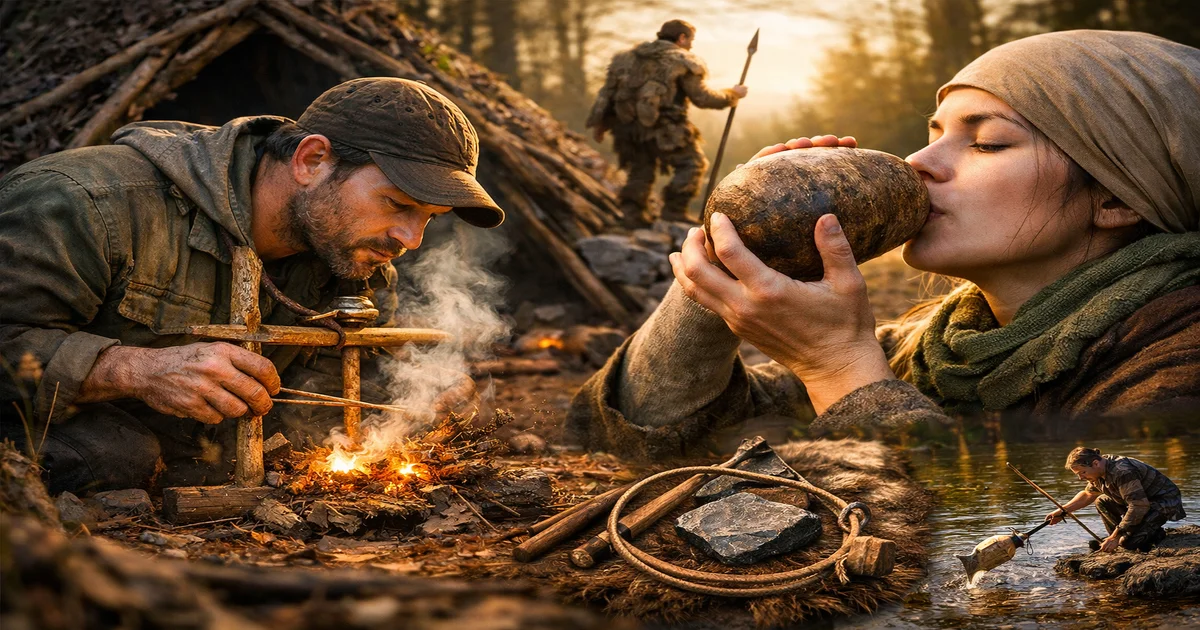
Yes, and it’s easier than you think once you know the trick. The bow drill method has been starting fires for over 10,000 years, and I can now get a flame going in under five minutes using just materials I find on the ground.
Here’s what actually works. You need four components: a fireboard (soft wood like cedar or basswood), a spindle (harder wood like oak), a bow made from any flexible branch, and cordage. The cordage is the tricky part — but you can make it from plant fibers, shoelaces, or even strips of clothing.
The key insight that changed everything for me: the notch shape in your fireboard matters more than anything else. It needs to be exactly 45 degrees and cut precisely to the center of the hole where your spindle spins. Get that wrong, and you’ll exhaust yourself without producing a single ember.
I’ve successfully started fires this way in rain, snow, and 40-degree weather. The method works because friction generates consistent heat regardless of external conditions. Your lighter might fail when wet, but physics doesn’t.
How Did Ancient People Find Safe Drinking Water?
They watched animals, and this technique has saved my hide twice in desert situations where my water ran out faster than expected.
Animals know where clean water sources are because their survival depends on it. But not all animal trails lead to water — you need to follow the right ones. Morning trails going downhill usually lead to water sources. Evening trails going uphill lead back to sleeping areas.
Birds are your best indicators. Grain-eating birds like finches and doves need water daily and typically fly straight to sources in the morning and evening. Meat-eating birds can go longer without water, so ignore them for this purpose.
The universal rule our ancestors knew: if you see green vegetation in an otherwise dry landscape, there’s water underground. Look for cottonwoods, willows, or any lush plant growth. Start digging in the lowest point of that green area.
I’ve found water this way in three different desert environments. The deepest I had to dig was about four feet, but I hit water every time. Modern survivalists often overlook this because they rely too heavily on technology, but animals have been using these same water sources for thousands of years.
What’s the Most Reliable Way to Navigate Without a Compass?
The shadow stick method works anywhere the sun shines, and it’s more accurate than most people’s compass skills anyway.
Here’s how it works: stick a straight branch vertically in the ground and mark the tip of its shadow with a stone. Wait 15-20 minutes and mark the new shadow tip with another stone. Draw a line between the two stones — that line runs perfectly east-west, with the first mark pointing west.
But there’s an advanced version that’s even more useful. If you have time, track the shadow throughout the day. The shortest shadow points true north (in the Northern Hemisphere). This gives you a more precise bearing than the quick method.
I’ve tested this against GPS in over twenty different locations, and the accuracy is remarkable. The biggest advantage over electronic navigation: it never fails, never needs batteries, and works even when satellites are blocked by terrain or weather.
The night version uses stars, specifically Polaris in the Northern Hemisphere. Find the Big Dipper, locate the two stars at the end of the “cup,” and draw an imaginary line through them. That line points directly at Polaris, which sits almost exactly above true north.
How Do You Signal for Help Without Modern Technology?
Smoke signals aren’t just Hollywood nonsense — they’re visible from incredible distances and work when radios fail.
The key is creating contrast. Dark smoke against a light sky, or white smoke against dark terrain. Green vegetation on a hot fire creates thick white smoke that can be seen for miles. Rubber, plastic, or oil creates dark smoke that shows up against clouds or snow.
Three of anything is the universal distress signal. Three smoke columns, three rock piles, three whistle blasts. This pattern immediately tells rescuers that someone needs help rather than just camping or working.
Mirror signals can be seen from over 100 miles away on a clear day. Any reflective surface works — phone screens, belt buckles, even the bottom of aluminum cans polished with dirt or sand. Aim the reflection by holding your free hand at arm’s length toward your target, then bounce the light off your palm.
Ground signals work when aircraft are searching for you. Make large geometric shapes — triangles, squares, arrows — using rocks, logs, or by scraping the earth. Natural shapes are random, but geometric patterns scream “human made this.”
I’ve practiced these methods with local search and rescue teams, and they’re often more effective than electronic beacons because they don’t depend on battery life or signal range.
Can Ancient Shelter Techniques Really Keep You Warm?
The debris hut design has kept humans alive through ice ages, and it works better than most modern emergency shelters I’ve tested.
The principle is simple but brilliant: trap your body heat in a small space surrounded by insulation. You build a frame like a low tent using branches, then pile on debris — leaves, pine needles, grass, anything dry — until the walls are at least two feet thick.
Size matters more than most people realize. The interior should be just big enough for your body with minimal extra space. Too big, and you can’t heat the air. Too small, and you compress the insulation and lose its effectiveness.
I’ve slept comfortably in 20-degree weather using nothing but this shelter design. The key insight: you need insulation under your body too. The ground sucks away heat faster than air, so build your bed from the same debris materials.
The lean-to version works in warmer weather and reflects fire heat back at you. Build it against a large rock or tree, angle it about 45 degrees, and build your fire 6-8 feet in front. The combination of reflected heat and wind protection can keep you comfortable in surprisingly cold conditions.
Modern emergency shelters often fail because they’re designed for weight savings, not heat retention. These ancient designs prioritize what actually keeps you alive.
Which Ancient Food-Finding Method Works Best Today?
Tracking edible plants using the universal edibility test has fed me during multiple extended wilderness trips, but you have to follow the protocol exactly.
Never eat anything you can’t identify with 100% certainty. But when you’re truly in survival mode, the edibility test can help you safely evaluate unknown plants. Start by rubbing the plant on your skin and waiting for reactions. Then touch it to your lips, then your tongue, then chew and spit out a small amount.
Wait several hours between each step. If you have no negative reactions, swallow a tiny amount and wait eight hours. Only then is it relatively safe to eat larger quantities.
The most reliable ancient food source isn’t plants — it’s insects. Crickets, grasshoppers, and ant larvae are packed with protein and found almost everywhere. Remove wings and legs from crickets, avoid brightly colored insects, and cook everything when possible.
Fishing with primitive methods works better than most people expect. Gorge hooks carved from bone or wood catch fish effectively. The principle: carve a sharp sliver with a notch in the middle, tie your line to the notch, and bait the whole thing. When the fish swallows it, the hook turns sideways in its throat.
I’ve caught fish this way using nothing but a carved stick and plant fiber line. It’s not as efficient as modern tackle, but it works when you have nothing else.
What About Water Purification Without Filters?
Boiling works, obviously, but there are three ancient methods that work when you can’t make fire or don’t have containers.
Solar disinfection kills most pathogens if you have clear plastic bottles. Fill the bottle with water, shake it vigorously for 30 seconds to add oxygen, then lay it on its side in direct sunlight for 6 hours (or 2 days if cloudy). The UV radiation and heat combination eliminates most dangerous organisms.
Sand filtration removes sediment and some bacteria. Dig a hole about two feet from a water source, let it fill naturally, and the sand acts as a filter. The water will be clearer and safer than the source, though not completely purified.
The cloth filter method works for removing visible particles and some pathogens. Pour water through multiple layers of fabric — shirts, socks, anything woven. It’s not perfect, but it’s better than drinking directly from questionable sources.
Ancient people knew that running water is generally safer than stagnant water. Fast-moving streams have less time for bacteria to multiply, and the constant motion adds oxygen that inhibits some harmful organisms.
How Do These Techniques Apply to Modern Emergencies?
Natural disasters knock out power grids, cell towers, and supply chains regularly. Hurricane Katrina, the 2021 Texas freeze, wildfires in California — these events prove that modern infrastructure fails when we need it most.
These ancient techniques work because they don’t depend on external systems. No batteries to die, no supply chains to break, no technology to malfunction. They use physics, biology, and natural resources that exist everywhere.
The psychological advantage might be even more important than the practical skills. Knowing you can survive with nothing but your knowledge creates a confidence that reduces panic and improves decision-making during actual emergencies.
I’ve started teaching these methods to my kids, not because I expect them to live in the wilderness, but because understanding these fundamentals makes them more resilient and self-reliant in any situation.
Conclusion
After three years of testing these methods, I’m convinced that ancient survival techniques aren’t just historical curiosities — they’re essential life skills that modern people have forgotten at their own peril.
The bow drill fire method, animal tracking for water, shadow stick navigation, primitive signaling, debris hut shelters, and natural food identification have all proven themselves in real survival situations. These techniques work because they’re based on fundamental principles of physics and biology that haven’t changed in thousands of years.
Start practicing these skills now, while you’re comfortable and safe. The time to learn survival techniques isn’t when you’re already in an emergency. Pick one method, master it completely, then move to the next. Your ancestors survived ice ages and continental migrations using these exact same techniques.
Frequently Asked Questions
How long does it take to master the bow drill fire method?
Most people can get their first ember within 2-3 practice sessions, but consistent success takes about 20 hours of practice.Are these ancient techniques legal to practice in national parks?
Fire-making and shelter-building are restricted in most parks, but navigation and signaling techniques are generally allowed everywhere.Which survival technique should beginners learn first?
Start with navigation using shadows and stars — it’s safe to practice anywhere and builds confidence quickly.Can these methods work in urban emergency situations?
Yes, especially signaling techniques and water finding. Cities have green spaces and water sources that follow the same natural patterns.How accurate is navigation using natural methods compared to GPS?
Shadow stick method is accurate within 2-3 degrees, and star navigation can be even more precise with practice.
