

How Often Should You Walk a Labrador Each Day?
Most people who bring home a Labrador assume a quick trip around the block will do the trick. It won’t. Labs are working dogs built for endurance, and getting their daily walk schedule wrong leads to chewed furniture, destructive behavior, and real health problems down the line.
TL;DR
- A healthy adult Labrador needs at least 80 minutes of quality exercise daily, split across 2-3 walks.
- If your Lab is under 12 months old, the 5-minute rule applies: 5 minutes of exercise per month of age, twice per day.
- Check your dog’s behavior, not just the clock. Destructive chewing and excessive barking are the clearest signs of under-exercise.
How Many Times a Day Should You Walk a Labrador?
The honest answer is: at least twice, and ideally three times. Think of it like a pressure valve. A Lab that goes out once in the morning and sits home alone for eight hours is building pressure all day. By the time you get back, that pressure has to go somewhere. Usually it goes into your couch cushions.
Split the total daily exercise into 2 to 3 sessions: a morning walk or run to burn initial energy, a midday mental game or short walk, and an evening play session to ensure calmness before bed. This prevents energy spikes and destructive behavior.
Consistency matters more than perfection. Same times each day, same general structure, and your Lab will settle into the rhythm quickly. Frequency without quality is still a waste of everyone’s time, which is what the next section breaks down.
How Long Should Each Walk Be for an Adult Lab?
A healthy adult Labrador generally needs at least 80 minutes of high-quality exercise per day. Aim for at least one long walk of 30 to 60 minutes daily, supplemented with shorter walks or potty breaks.
Here is the thing: quality beats quantity every single time. A plod around the block on a lead for 45 minutes just won’t do. Try to incorporate off-lead time into their exercise routine and take a ball or toy to play fetch with, since running will help raise their heart rate.
A useful rule of thumb: if your Lab is walking beside you at a leisurely pace, aim for a good hour and a half a day, not necessarily all in one go. Add in fetch, swimming, or a training session, and you can trim that walking time down considerably.
the quality of each walk matters far more than the total number of minutes on the leashWhat Is the Right Exercise Schedule for a Lab Puppy?
This is where most new Lab owners get it badly wrong. Puppies look full of energy, so the instinct is to let them run until they drop. That instinct can cause real, lasting damage to developing joints.
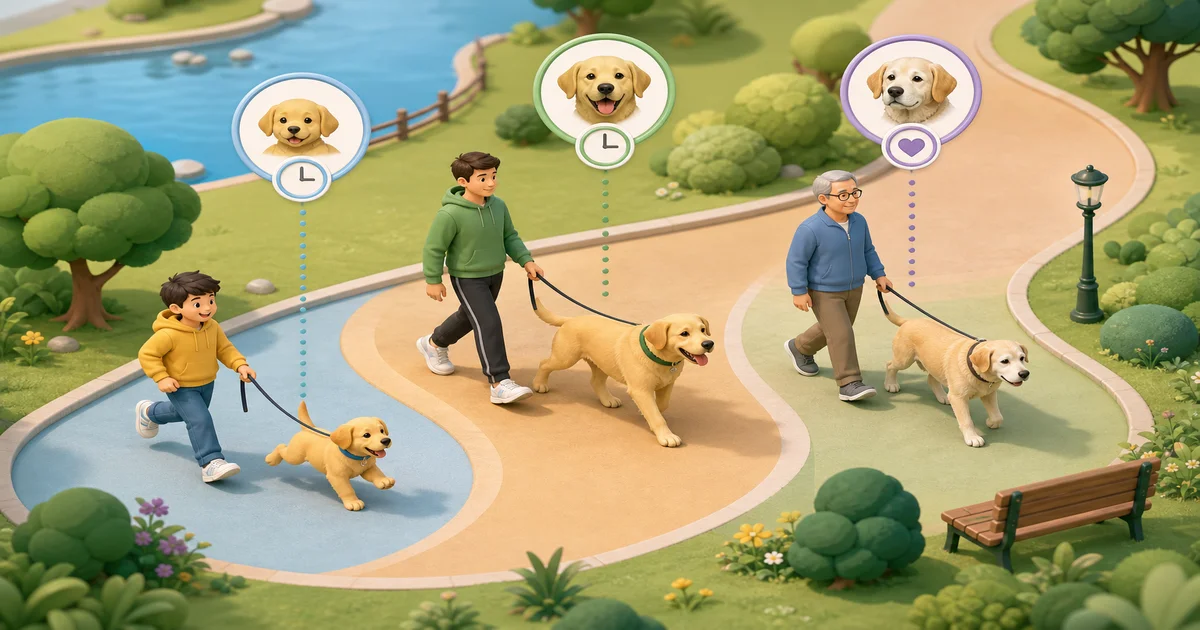
The standard guideline used by most vets and breeders is the Five Minute Rule: from three months of age, allow five minutes of exercise for each month the puppy is old, twice per day, until your Lab is at least one year old.
In practical terms, this looks like:
| Age | Session Length | Sessions Per Day |
|---|---|---|
| 3 months | 15 minutes | 2 |
| 4 months | 20 minutes | 2 |
| 6 months | 30 minutes | 2 |
| 12 months | Up to 60 minutes | 1-2 |
Between 12 and 18 months, your Labrador is nearing maturity, but growth plates may still be developing until 18 to 24 months. One more thing worth knowing: puppies are being walked to help with socialization and leash skills rather than a need for exercise per se. Let them guide the activity, sniffing and investigating. They will usually stop and sit if they need a rest.
How Much Exercise Does a Senior Labrador Need?
Old dogs need walks too. The mistake here runs in the opposite direction: owners see their Lab slowing down and cut exercise almost entirely. That is the wrong call.
Senior Labradors typically need 30 to 60 minutes of gentle exercise daily, broken into 2 to 3 shorter sessions of 10 to 20 minutes each. This is significantly less than the 60 to 120 minutes that adult Labs require, but consistency of movement becomes even more important as they age.
According to veterinary orthopedic specialists, regular low-impact movement promotes circulation of synovial fluid, which acts as a natural lubricant and shock absorber within joint spaces. This is particularly important for senior Labs developing arthritis or other degenerative joint conditions, as gentle consistent movement helps maintain flexibility while preventing stiffness from prolonged inactivity.
Older dogs may develop arthritis or hip dysplasia that requires modifications to their routine. Focus on low-impact activities like swimming or gentle walks, break exercise into shorter and more frequent sessions, and pay close attention to your dog’s energy levels after each outing.
for senior Labs, two or three short gentle walks daily beats one long exhausting outing every timeWhat Happens If You Don’t Walk Your Labrador Enough?
Short answer: chaos. Longer answer: physical and behavioral problems that compound over time.
Without adequate exercise, Labradors can quickly become overweight and develop behavioral issues. This is not a personality flaw in your dog. It is a physiological response to unspent energy with nowhere to go. Research from veterinary behaviorists suggests that Labs under-exercised for two or more consecutive weeks typically begin showing destructive behaviors within the first three to five days, with chewing and digging escalating noticeably by the end of the second week.
There is also a specific trap called “weekend warrior syndrome.” Owners try to fit a week’s worth of exercise into the two days at the end of the week, which is typically detrimental to the dog’s health. Consistency across all seven days is the only approach that works.
Just like us, Labradors have a cardiovascular system that becomes more efficient the more it is used. Exercise builds muscle, strengthens bones, protects against injury, and increases potential lifespan. The bigger question is whether you can actually walk your Lab too much, which is what the next section covers.
Can You Walk a Labrador Too Much?
Yes. And it is more common than people think, especially with younger dogs and enthusiastic new owners.
Being the loyal companions they are, Labradors will push through a lot of pain to keep up with you. Watch for panting that does not subside within 10 minutes of rest, a respiratory rate above 40 breaths per minute, changes in their gait, or unusual exhaustion after a session. Any of these signals means they have overstretched themselves.
Avoid high-impact activities like jumping in or out of cars, long-distance ball or frisbee throws, agility exercises, flyball, excessive stair climbing, and abrupt fast turns until your Labrador is at least 2 to 3 years old. Growth plates in large breeds close later than most owners expect, and repetitive high-impact stress before that point can cause problems that show up years later.
A quick reality check: if your Lab is limping after a walk, moving stiffly the next morning, or showing reluctance to head out, those are signals to back off and consult your vet. Do not push through those signs.
Does Mental Stimulation Count as Exercise?
This one surprises most people. The answer is a clear yes.
Mental activities engage your Lab’s incredible mind, forcing them to focus, solve problems, and think critically. A 15-minute brain game can tire a dog out as much as a 30-minute walk.
Puzzle feeders, scent work, obedience training sessions, and hide-and-seek games with treats all count toward your Lab’s daily mental quota. This matters practically on days when weather or schedule makes a full walk impossible. A 20-minute training session indoors, combined with a shorter outdoor walk, can satisfy a Lab far better than skipping exercise entirely.
a 15-minute puzzle session combined with a brisk walk beats a long, boring leash drag any day of the weekWalking Your Lab in Hot or Cold Weather: What to Know
Timing and conditions matter more than most owners factor in.
In summer, stick to early morning or evening walks. Pavement absorbs and radiates heat, and a Lab’s paw pads can burn on surfaces that feel only warm to your hand. A simple test: press the back of your hand to the pavement for seven seconds. If it is uncomfortable for you, it is painful for your dog.
Labradors are also predisposed to exercise intolerance, and you will need to remember this when exercising your dog, especially during summer months when heat will exacerbate any problems with exertion. In winter, Labs generally handle cold weather better than heat, but icy surfaces are a joint risk for older dogs. Shorter, more frequent walks on cleared paths are smarter than one long slip-and-slide adventure.
Conclusion
Walk your adult Lab at least twice a day, aim for 80 minutes of real activity spread across those sessions, and never treat a slow leash plod as a substitute for genuine exercise. Adjust the schedule as your dog ages: structured short sessions for puppies, real intensity for adults in their prime, and gentle consistency for seniors. Start tracking your Lab’s daily activity this week and adjust one walk to include off-lead time or a fetch session. The difference in your dog’s behavior will be obvious within days.
Frequently Asked Questions
-
How many walks does a Labrador need per day?
Most adult Labs need at least 2 walks daily, ideally 3. Aim for a total of 80 to 90 minutes of purposeful activity split across those sessions. -
Can I walk my Lab puppy for an hour?
No. Follow the 5-minute rule: 5 minutes of exercise per month of age, twice daily. A 4-month-old puppy should walk no more than 20 minutes per session. -
What happens if a Labrador doesn’t get enough exercise?
Expect destructive behavior like chewing, digging, and excessive barking. Long-term under-exercise also contributes to obesity and joint problems. -
Is swimming a good substitute for walking a Labrador?
Yes. Swimming is low-impact, joint-friendly, and highly effective. It is especially useful for senior Labs or dogs with hip dysplasia. -
How do I know if my Labrador is getting enough exercise?
A well-exercised Lab is calm at home, maintains a healthy weight, and is not destructive. Panting that doesn’t subside within 10 minutes of rest or stiffness the next morning signals you may be overdoing it.