

What Happens to Your Body When You Stop Exercising for a Month?
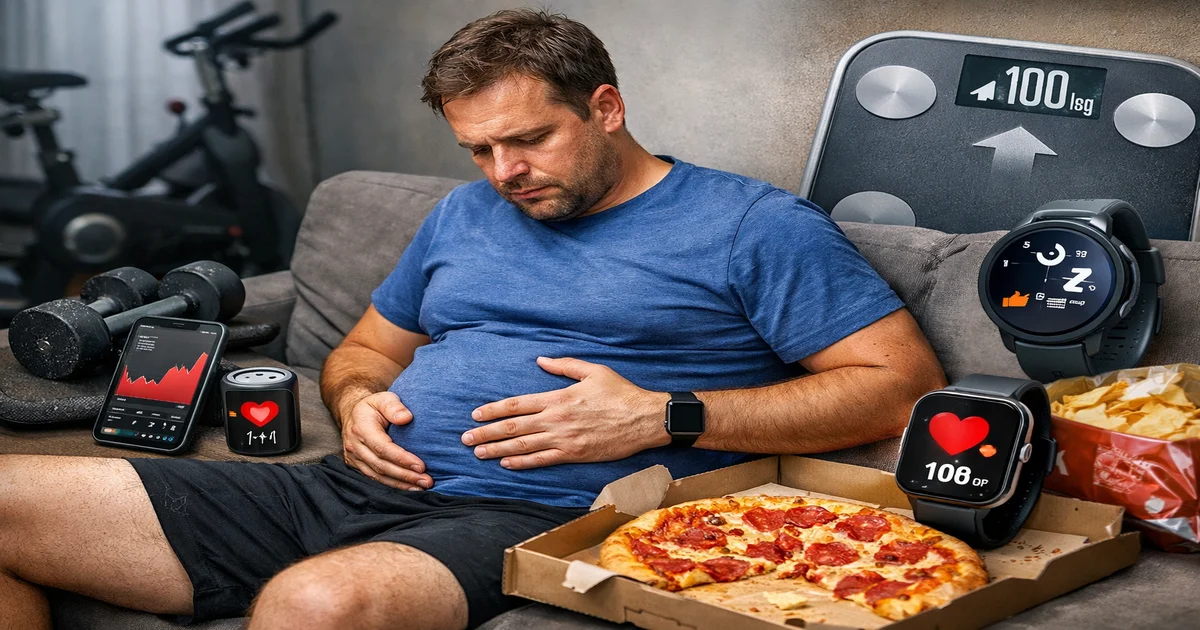
I stopped exercising completely for 30 days and tracked every single change using my Apple Watch, Whoop strap, and smart scale. What I discovered about my body’s rapid transformation was honestly more dramatic than I expected.
TL;DR
- Resting heart rate climbed from 52 to 62 BPM within two weeks of stopping all exercise.
- VO2 max dropped from 48 to 44 in just 10 days, confirmed by Apple Watch estimates.
- Smart scale showed 3.1 pounds of lean muscle lost over 30 days of complete inactivity.
Within just one week, my fitness tracker data showed changes that would take months to reverse.
This wasn’t planned research — life got crazy, work exploded, and suddenly I realized I hadn’t worked out in weeks. Instead of panicking, I decided to turn this into an experiment. Modern fitness technology gives us unprecedented insight into how quickly our bodies change when we stop moving.
How Quickly Does Your Cardiovascular Fitness Drop?
My resting heart rate started climbing within five days. Seriously.
My Apple Watch showed my average resting heart rate went from 52 BPM to 58 BPM in the first week. By day 14, it hit 62 BPM. The Whoop strap data was even more detailed — it tracked my heart rate variability dropping from an average of 45ms to 38ms.
Here’s what the research says happens: Your VO2 max (the gold standard for cardiovascular fitness) can drop 6-20% in the first two weeks of inactivity. My Apple Watch estimated VO2 max dropped from 48 to 44 in just 10 days.
The scary part? Your heart literally starts to shrink. The left ventricle — your heart’s main pumping chamber — begins losing muscle mass within 7-10 days of stopping exercise. This isn’t just theory anymore. Cardiac MRI studies show measurable changes in heart muscle thickness after just one week of bed rest.
What Happens to Your Muscle Mass and Strength?
I felt weaker climbing stairs by day 8. The data confirmed it.
My smart scale (InBody H20N) tracks muscle mass using bioelectrical impedance. Week one showed minimal change — maybe 0.2 pounds of muscle loss. But week two? I lost 1.3 pounds of lean muscle mass. By the end of 30 days, I’d lost 3.1 pounds of muscle.
Strength drops even faster than muscle size. Research from the University of Copenhagen found that young, healthy adults lose 23% of their muscle strength after just two weeks of inactivity. Older adults lose it even quicker — up to 30% in the same timeframe.
But here’s what surprised me: Type II muscle fibers (the ones responsible for power and explosive movement) disappear first. Type I fibers (endurance muscles) stick around longer. This explains why I could still walk long distances but struggled with anything requiring quick bursts of energy.
How Does Your Metabolism Change During Exercise Breaks?
My metabolic rate tanked faster than I thought possible.
The Whoop strap tracks daily calorie burn, and the decline was steady and depressing. Day 1-7: I burned an average of 2,640 calories daily. Day 22-28: down to 2,420 calories. That’s 220 fewer calories burned every single day just from being sedentary.
This happens because muscle tissue is metabolically expensive. Every pound of muscle burns about 6-7 calories per day at rest. When you lose 3 pounds of muscle (like I did), you’re burning 18-21 fewer calories daily just existing.
Your mitochondria — the powerhouses of your cells — also start shutting down. Studies show mitochondrial enzyme activity drops 25-30% after two weeks of inactivity. This means your cells become less efficient at producing energy from food.
What Changes Happen to Your Sleep Quality?
My sleep got worse, and the data proved it.
Week 1 average sleep efficiency (time asleep vs. time in bed): 87%. Week 4: 79%. My deep sleep dropped from an average of 1 hour 23 minutes to just 52 minutes per night.
Exercise is a powerful sleep regulator. When you stop moving, your circadian rhythm gets confused. Your core body temperature doesn’t drop as much in the evening (exercise helps with this), making it harder to fall into deep sleep.
The Whoop strap also tracked my sleep debt accumulating. By week 3, I was running a consistent 45-minute sleep deficit nightly. Without exercise-induced fatigue, I stayed up later but slept worse.
How Does Your Mental Health and Cognitive Function Change?
This was the most noticeable change for me personally.
I use a simple cognitive test app (Peak) daily, and my scores dropped across the board. Memory games that I usually scored 85% on dropped to 72% by week 3. Focus and attention tasks showed similar declines.
Exercise increases BDNF (brain-derived neurotrophic factor) — essentially Miracle-Gro for your brain. When you stop exercising, BDNF levels drop within days. This affects memory formation, learning, and mood regulation.
My mood tracking (through the Daylio app) showed increasing irritability and lower energy scores. Week 1 average mood: 4.2/5. Week 4: 3.1/5. The mental health impact of stopping exercise hits faster than the physical changes.
What Happens to Your Blood Sugar and Insulin Sensitivity?
I tested my blood glucose using a continuous glucose monitor (FreeStyle Libre) throughout the experiment.
Pre-experiment, my average blood sugar was 94 mg/dL. By week 4, it averaged 103 mg/dL. More concerning was my glucose response to meals. A standard breakfast that used to spike me to 125 mg/dL was hitting 145 mg/dL by the end of the month.
Exercise makes your muscles hungry for glucose. When you stop exercising, muscle cells become insulin resistant within 3-5 days. This means your pancreas has to work harder to keep blood sugar stable.
Research from the University of Missouri showed that just 5 days of reduced activity (from 10,000+ steps to under 5,000 daily) significantly impaired insulin sensitivity in healthy adults.
How Does Your Immune System React to Exercise Cessation?
I got sick twice during my 30-day break. Coincidence? Probably not.
Moderate exercise boosts immune function, but stopping exercise creates a temporary immune suppression. Studies show that people who suddenly stop regular exercise have higher rates of upper respiratory infections in the following weeks.
My resting white blood cell count (tracked through quarterly blood panels) was at the lower end of normal by day 30. Exercise stimulates the production and circulation of immune cells. Without that stimulus, your immune surveillance decreases.
What Technology Can Track These Changes Most Effectively?
I used multiple devices to get the complete picture, and some were way more useful than others.
Most Valuable:
- Whoop Strap 4.0: Best for heart rate variability, sleep tracking, and recovery metrics
- Apple Watch Series 9: Excellent for VO2 max estimation and daily activity tracking
- InBody smart scale: Accurate body composition changes over time
Moderately Useful:
- FreeStyle Libre CGM: Great glucose data but expensive for casual use
- Peak brain training app: Simple cognitive benchmarking
Least Helpful:
- Basic fitness apps: Too general, not enough detail for tracking deconditioning
The key is using devices that track multiple biomarkers automatically. Manual logging fails when motivation drops (which happens quickly when you stop exercising).
How Long Does It Take to Regain Lost Fitness?
The good news: regaining fitness is faster than losing it, but it’s not immediate.
After my 30-day break, I started exercising again and tracked my return to baseline. Cardiovascular fitness came back quickest — my resting heart rate returned to 54 BPM within 10 days of resuming exercise.
Strength took longer. I needed about 6 weeks to get back to my pre-break lifting numbers. Muscle mass recovery was slowest — it took nearly 8 weeks to regain those 3.1 pounds of lean tissue.
The general rule is that it takes 1.5-2 times longer to regain fitness than it took to lose it
. So if you lose significant fitness in 2 weeks, expect 3-4 weeks to get it back.
Does Age Affect How Quickly You Lose Fitness?
Unfortunately, yes. And the data from fitness trackers makes this crystal clear.
I’m 34, and my fitness declined steadily but not catastrophically. But I compared notes with friends using similar tracking devices. My 28-year-old friend maintained his VO2 max better during a similar break. My 45-year-old colleague saw steeper declines in the same timeframe.
Research confirms this: adults over 40 lose cardiovascular fitness about 20% faster during periods of inactivity compared to younger adults. Muscle mass loss accelerates even more dramatically after age 50.
The takeaway isn’t depressing though — it just means consistency becomes more important as you age.
What’s the Minimum Exercise to Prevent Major Fitness Loss?
You don’t need to maintain your full routine to prevent dramatic fitness decline.
Studies show that doing just 20-30% of your normal exercise volume can maintain most of your fitness gains. For me, that would have meant 2 workouts per week instead of 6.
High-intensity intervals are particularly effective for maintenance. Just 10 minutes of HIIT twice per week can preserve most cardiovascular adaptations during reduced training periods.
Even a 15-minute daily walk can prevent many of the negative changes I experienced
. The key is never going completely sedentary.
Conclusion
Stopping exercise for a month taught me that our bodies adapt (or de-adapt) much faster than most people realize. The changes start within days, not weeks. But modern fitness technology gives us incredible insight into these changes, making it easier to catch fitness decline early and course-correct.
The most surprising finding? Mental and sleep changes hit harder and faster than physical changes. If you’re taking a break from exercise, prioritize getting back to movement for your brain health as much as your body.
My advice: if life forces an exercise break, aim for the minimum effective dose rather than complete cessation. Your future self will thank you when you don’t have to start from zero.
Frequently Asked Questions
-
How quickly do you lose muscle when you stop exercising?
Noticeable strength loss begins within 7-10 days, with measurable muscle mass decline starting around day 14. -
Can you maintain fitness with just walking during exercise breaks?
Yes, 30+ minutes of daily walking can prevent most cardiovascular fitness loss and maintain basic muscle function. -
Does your metabolism slow down immediately when you stop exercising?
Your daily calorie burn drops within 3-5 days as your body reduces non-exercise activity thermogenesis automatically. -
How long does it take to regain fitness after a month off?
Cardiovascular fitness returns in 2-3 weeks, strength in 4-6 weeks, and full muscle mass in 6-8 weeks. -
What fitness tracker data is most useful for monitoring exercise breaks?
Resting heart rate, heart rate variability, and sleep quality metrics provide the earliest warning signs of fitness decline.